Suites Harmoniques

Description
Technical description of the work
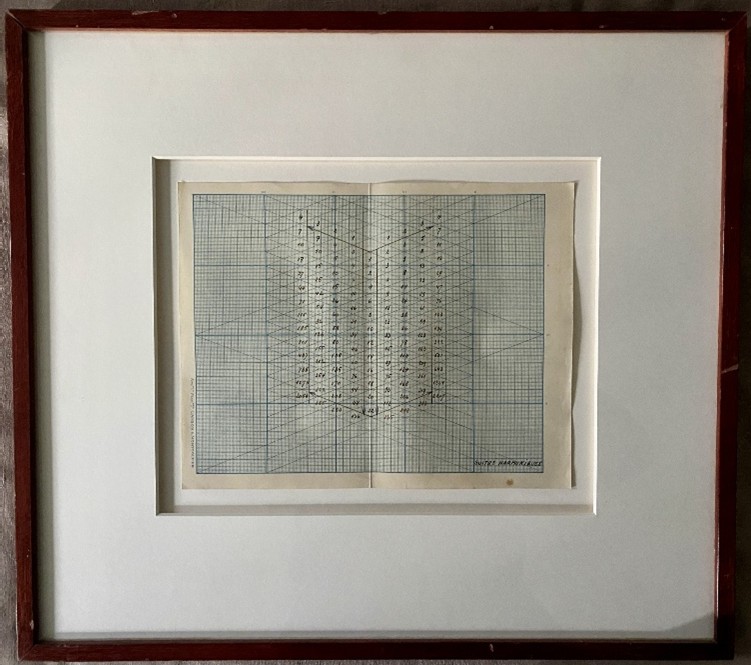
Georges Herbiet, known as “Christian”, belongs to the generation of Belgian artists who, in the 1920s, gravitated around the European avant‑gardes. Close to Francis Picabia and the Duchamp–Crotti–Villon circle, he contributed to several avant‑garde journals (L’Esprit Nouveau, Action, 391, Ça ira) and published a single issue of the Dadaist review La Pomme de pains. The use of graph paper — a medium associated with geometry and modelling — reflects a desire to divert the tools of rationality toward a poetic purpose. This choice is all the more significant given that, in the 1920s, “Anciennes Manufactures Canson & Montgolfier” graph paper was not yet available to the general public: it was reserved for professional circles (engineers, architects, technical schools) and would not be sold in school packets until 1947. The work presented here, dated 1923–1925, belongs to the late phase of Belgian Dada, when artists were exploring systems, structures, and internal logics.
Artitst and Contexte
Georges Herbiet, known as “Christian” (1895–1969)
“Herbiet constructs his works as systems: each element responds to an internal, almost mathematical logic.” — Jean‑Pierre Delarge – Dictionnaire des arts plastiques modernes et contemporains
The composition is built upon a precise geometric structure in perspective. Vanishing lines and the graph‑paper grid define a rigorous, almost architectural space. Within this structure, Christian arranges numbers according to an internal logic, evoking a serial system. This approach echoes avant‑garde graphic experiments, notably Picabia’s mechanical diagrams or the conceptual schemata of the Puteaux group. The work reflects an autonomous system based on numerical progression and spatial distribution. The handwritten inscription “Suites Harmoniques”, the only intentional indication left by the artist, suggests a serial organisation in which each number participates in an invisible order. The work demonstrates a clear interest in mental structures and internal relationships.
Movement
Geometric abstraction
“The diagram becomes an image, the image becomes thought: the avant‑gardes turned calculation into a mode of vision.” — Élie Faure – L’Esprit des formes, 1927
The inscription “Suites Harmoniques”, visible in the lower right corner, acts as a key to interpretation. It points to a serial logic grounded in mathematical relationships, internal progressions or distribution structures. The composition becomes a visual matrix, a space in which each number occupies a position defined by the grid. The work oscillates between scientific rigour and graphic intuition. The graph paper, perspective construction and numerical notation coexist to produce an image that is both legible and enigmatic. This tension between diagram and image, between calculation and visual thought, is characteristic of late Dadaist experimentation.
Interpretation
on the work
The inscription “Suites Harmoniques”, visible in the lower right corner, acts as a key to interpretation. It points to a serial logic grounded in mathematical relationships, internal progressions or distribution structures. The composition becomes a visual matrix, a space in which each number occupies a position defined by the grid. The work oscillates between scientific rigour and graphic intuition. The graph paper, perspective construction and numerical notation coexist to produce an image that is both legible and enigmatic. This tension between diagram and image, between calculation and visual thought, is characteristic of late Dadaist experimentation.
Insight
Curatorial note
A rare Belgian Dada piece with distinguished international exhibition history
The work belongs to the corpus presented in the Centre Pompidou’s Dada exhibition (2005–2006) and appears in the catalogue alongside a closely related piece reproduced on page 217. This institutional presence confirms the recognition of Christian’s singular role within the late avant-gardes. The catalogue highlights the way he diverts the tools of rationality, turning them into vectors of a mental construction.The precision of the line, the symmetry of the structure and the placement of the numbers reveal a mastery of technical drawing placed at the service of conceptual inquiry. The catalogue emphasises the “scientific‑poetic” dimension of these works, which explore systems, internal relationships and serial structures. The handwritten inscription “Suites Harmoniques” reinforces this orientation : the artist conceives his drawing as an open system, founded on relationships rather than figuration. Through its provenance, dating, inscription and inclusion in an international reference exhibition, this piece stands as a rare and valuable testimony to Belgian Dada and its graphic extensions.
GALLERY
SPECIFICATIONS


Contact
