Scene on Olympus

Description
Technical description of the work
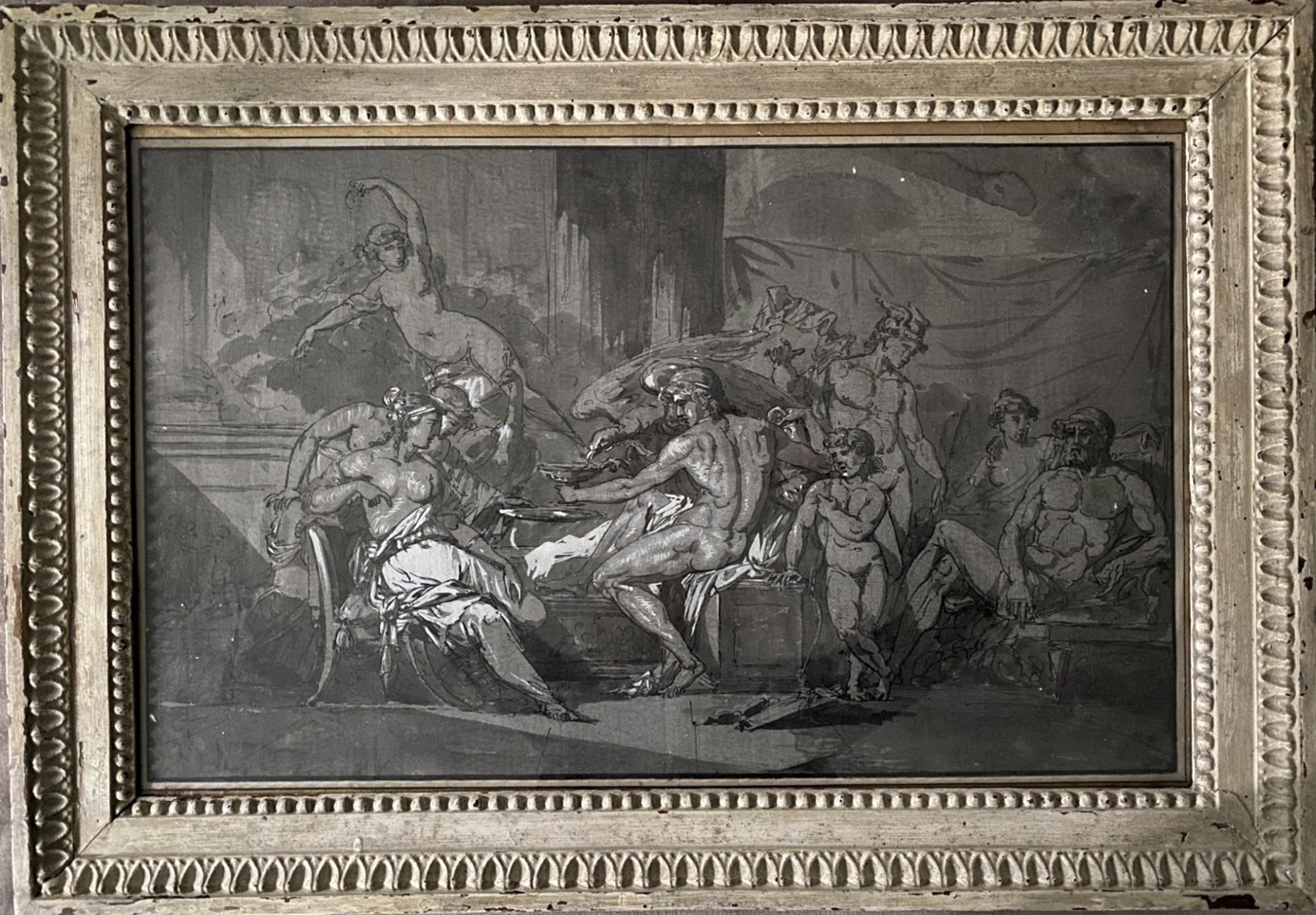
This wash drawing illustrates the myth of Ganymede, a mortal youth of exceptional beauty, abducted by Jupiter transformed into an eagle to become the cupbearer of the gods. The composition shows Ganymede offering a cup to the eagle, while a servant presents a tray. Opposite him, Hera, accompanied by her peacock, observes with tranquil dignity. Above, Hecate flies with her keys, symbol of her ominous role as guide of souls. To the right, Hermes points out the scene to Zeus, bearded and reclining, as if to warn him of the tensions unfolding. The work combines several narrative registers in a learned composition, where each figure embodies a symbolic function. The strongly applied white highlights accentuate volumes and luminous effects. Their vigor suggests a demonstrative intention, typical of academic wash drawings of the 18th century, intended to be displayed or collected. This treatment reinforces the dramatic effect and legibility, confirming the hypothesis of a neoclassical origin.
Artist and contexte
In the manner of Jacques-Louis David
“The only way for us to become great, indeed, if possible, inimitable, is the imitation of the Ancients” Winckelmann – 1755
This wash belongs to the academic tradition of the 18th century, when French and Italian artists practiced gray ink wash heightened with white for mythological compositions. Attribution remains cautious: the work could be linked to the circle of Jacques-Louis David or to pupils trained in Rome, sensitive to neoclassical stylization and erudite iconography. The simultaneous presence of Ganymede, Jupiter, Hera, Hermes, and Hecate reveals a desire to go beyond mere illustration and to propose an allegorical reading of divine tensions.
Movement
Neoclacissisme
“These things never happened, but always are” — Sallustius – On the Gods and the World, 4
This drawing belongs to the neoclassical vein, heir to Poussin and the Roman academies, where mythology is represented as a theater of symbols. The gray wash, a subtle and meditative technique, suggests volumes and atmospheres without decorative excess. The economy of means, clarity of gestures, and hierarchy of figures reflect a search for balance and gravity. The work stands within a tradition where mythology becomes a mirror of human passions : desire, jealousy, destiny.
Movement
Neoclacissisme
“Love rules the gods and men ” — Hésiode -Théogonie, v. 120–122
The central scene, heightened with white — Ganymede offering the cup to Jupiter — embodies the elevation of a mortal to divine rank. Hera, calm yet distant, evokes jealousy and the fragility of celestial balance. Hecate, in flight, introduces a sinister dimension, like a shadow over Olympus. On the right, Cupid, bow in hand, visually connects a second scene: turned toward Hera and Ganymede, he recalls that divine desire is the origin of the abduction, while establishing a link with Zeus and Hermes. Cupid thus becomes the mediator of the narrative, revealing love as the hidden driving force of the action and the source of tensions. This parallel scene unfolds before a monumental drapery, which lends the composition a theatrical quality, as if staged upon a sacred platform. Hermes, vigilant messenger, draws Zeus’s attention to these tensions, in a gesture that may be read as a warning. Thus, the work does not merely recount a mythological episode: it juxtaposes the forces of desire (Cupid), jealousy (Hera), death (Hecate), and vigilance (Hermes), in a learned dramaturgy where the divine theater becomes a mirror of human passions.
Interpretation
of the work
Ganymede and the Gods — A Rare Neoclassical Scene
An allegory of divine tensions — between desire, jealousy, and destiny. This learned wash drawing reflects the iconographic richness of the eighteenth century, when mythology functioned as an allegorical language. The scene is rare: while Ganymede is often depicted at the moment of his abduction, he is far less frequently shown surrounded simultaneously by multiple deities, as he is here, in a complex dramaturgy uniting Hera, Hermes, Hecate, Zeus, and Cupid. Ganymede, figure of youth and immortality, engages with Hera, emblem of jealousy, under the gaze of Hecate, guide of souls. Hermes and Zeus complete this celestial staging, each deity embodying a moral force. The work condenses the core concerns of Neoclassicism: graphic stylization, poetic gravity, and moral interpretation. It becomes a meditation on the fragile balance of divine passions, and on the human condition transposed into the theatre of Olympus.
GALLERY
SPECIFICATIONS
Contact
