Unknown

Description
Technical description of the work
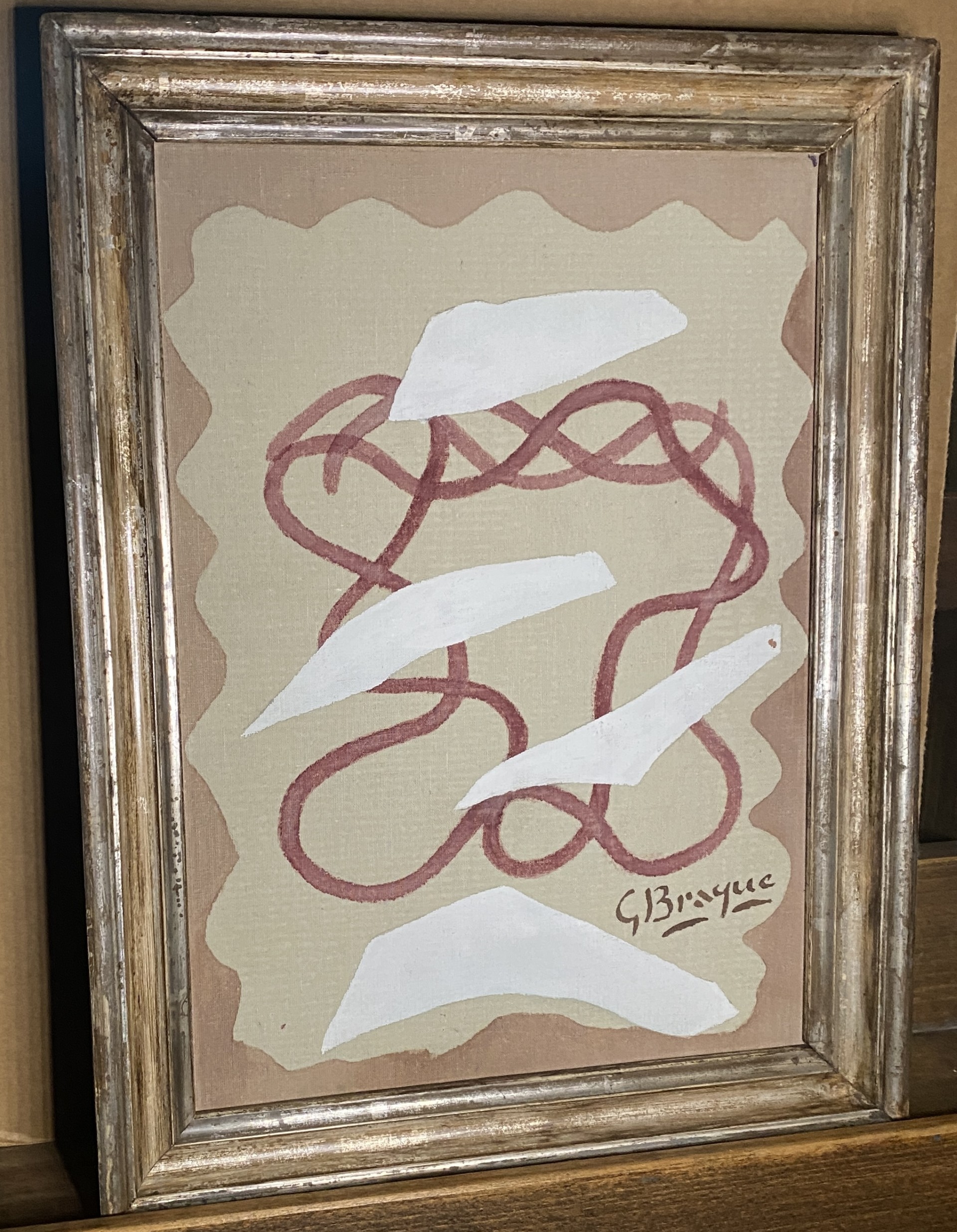
This work on paper belongs to the full maturity of Georges Braque, at the turn of the 1960s, a moment when the artist developed a highly liberated graphic language. The diluted red/brown gouache, applied in supple, continuous strokes, evokes an almost musical handwriting. The undulating painted border surrounding the sheet — a rare but documented motif — structures the composition like a breath circulating from the edges toward the center. A late lithograph such as L’Envol displays a similar vocabulary of sinuous lines suggesting an upward movement. This proximity of language situates the work within the continuity of Braque’s graphic research at the end of his life, when the artist, freed from the constraints of historical Cubism, explored a poetic abstraction based on rhythm, breath, and extreme simplification.
Artist and contexte
Georges Braque (1882 - 1963)
“The subject is not the subject” Georges Braque – Le Jour et la Nuit, 1952
From the 1950s onward, Braque frequently worked on paper, favoring modest supports — textured sheets, beige papers, sketchbooks — that allowed him great spontaneity. The artist pursued a line of inquiry initiated with the Cubist papiers collés but transposed into a freer vocabulary: the aim was no longer to describe an object, but to organize relationships between forms and signs. In this work, the diluted line reveals a rapid and confident gesture, while the white collages, cut with scissors and applied to the surface, introduce areas of visual silence. The whole reflects the maturity of an artist who seeks less to represent than to suggest, transforming the Cubist legacy into a more intimate and pared‑down form of writing.
Movement
Cubisme
“I do not believe in the thing seen, but in the thing felt.” — Georges Braque
The work belongs to Braque’s late Cubism, a moment when the artist definitively moved away from the analytical structures of Cubism to explore a poetic abstraction based on rhythm and breath. The painted undulating border, rare but documented in La Nuit la Faim (1960), is a strong indicator of this final phase. The continuous, supple, sinuous gesture evokes late lithographs such as L’Envol (1960), where Braque favored an ascending or circular movement rather than a geometric construction. The presence of white collages, a late reinterpretation of the papiers collés, confirms the inscription of this piece within the graphic research of 1958–62, a moment when the artist achieved a highly personal synthesis between Cubist heritage and lyrical abstraction. The dating c. 1960 is thus supported by the stylistic proximity to La Nuit la Faim and by the characteristics of Braque’s late graphic vocabulary.
Interpretation
Of the work
“The object must fade before the emotion” Georges Braque – Le Jour et la Nuit, 1952
The composition is built on a subtle dialogue between line and cut forms. The central, fluidly looping stroke organizes the space through a continuous movement. The four white collages, placed over this network of lines, appear to float above the surface: their lack of anchoring creates an impression of lightness, as if the elements were suspended in the air. This sensation of weightlessness echoes several of Braque’s late works, in which forms seem to detach themselves from the background rather than rest upon it. The ensemble does not refer to any identifiable motif: it is an abstract construction in which rhythm, tension, and breath take precedence over figuration. Here we find the rigor inherited from Cubism, but transposed into a freer language, where the internal dynamics of the image alone are enough to suggest movement. The work thus invites an active contemplation: it does not depict an object, it proposes a visual experience.
Insight
Curatorial note
A rare and accomplished late work by Georges Braque (c. 1960)
This gouache‑collage is a valuable testimony to Georges Braque’s late explorations on paper. The presence of the painted undulating border — a motif also found in La Nuit la Faim (1960) — is a strong indicator situating the work around this date. The quality of the line, the coherence of the gesture, the controlled spontaneity of the diluted gouache, and the signature characteristic of the years 1955–63 all reinforce this attribution. The use of white collages, cut, painted, and then applied to a ribbed beige background, gives the ensemble an airy dimension. Through its intimate format, its subtle balance between construction and freedom, and its proximity to the graphic research of the years 1958–62, this piece belongs to those late works that stand out for their precision, rarity, and profound unity.
GALLERY
SPECIFICATIONS


Contact
