Anthropomorphic Figure in Armor

Description
Technical description of the work
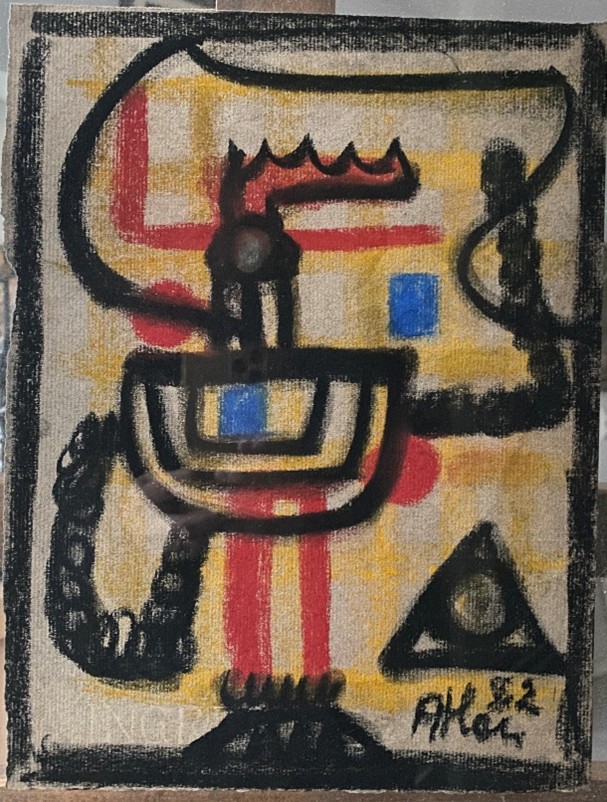
Created in 1952, when Atlan was 39 years old, this work on Ingres paper reflects the full maturity of his graphic language. The pastel, applied in matte areas and softer velvety highlights, interacts with the black contours that structure the figure. The frontal, taut, compact composition brings forth a stylized character whose presence asserts itself immediately. The work affirms the autonomy of the sign : the form does not describe, it summons an inner figure.
Artist and context
Jean-Michel Atlan (1913 - 1960)
“Atlan seeks to recover the power of the primal sign” Charles Estienne – art critic – Les Lettres Françaises
In 1952, Atlan was at the heart of his most fertile period. Living in Paris, he exhibited regularly and established himself as a singular figure of the postwar art scene. Self‑taught and nourished by philosophy, poetry, and the arts of ancient cultures, he developed a personal visual language, far from schools and dogmas. This period saw the emergence of totemic figures, stylized faces, and sign‑forms that condense an almost ritual energy. The present work belongs fully to this phase of formal intensity and the search for a universal language.
Movement
Expressionisme
“Atlan sought to create a language of living forms” Michel Ragon – Histoire de l’art abstrait – 1956
Atlan is often associated with lyrical abstraction and, briefly, with the CoBrA movement, yet his work escapes classification. He invented a visual script composed of signs, condensed silhouettes, and archaic forms. His vocabulary draws as much from calligraphy as from ancient arts, mythology, and abstraction. Here, pastel reinforces this hybrid dimension : a soft, almost flesh‑like material applied over a firm graphic structure. The work belongs to a symbolic, non‑narrative figuration in which the character becomes a sign.
Interpretation
of the work
“Atlan brings forth figures that partake of both sign and myth” Julien Alvard – art critic – Cimaise – mid‑1950s
In this untitled work, the central figure appears as an armored character, frontal and hieratic. The split rectangle of the face evokes a medieval helmet, topped with a crest or stylized feathers. The lateral elements, massive and articulated, recall metal‑clad arms, while the lower shapes evoke solerets, the protective foot pieces of armor.
Atlan does not depict a knight ; he invokes its presence through fragments and signs. The pastel brings a soft, almost human vibration, while the black contours impose a rigorous framework. The character oscillates between protection and vulnerability, between mask and face, between symbol and apparition. The work does not narrate ; it confronts us with a totemic being, an inner warrior.
Insight
Curatorial note
A totem‑figure, in direct resonance with the 1952 works held at the Centre Pompidou
This 1952 work belongs to the most sought‑after stylistic constellation of Atlan’s production : totemic figures and sign‑characters. The Centre Pompidou preserves several works from the same period (1952–1953) that display striking affinities : frontal silhouettes, powerful black contours, geometricized forms, stylized faces oscillating between mask and figure. The formal proximity between these public works and the present piece reinforces its place within Atlan’s mature period.
Here, the character reads as an archaic warrior, a being protected by a stylized helmet, armor‑like arms, and schematic solerets. This warrior dimension, never literal, contributes to the ritual force of the work. The wide, structured contemporary frame plays an active rôle : it acts as a frontal, almost votive setting that heightens the iconic presence of the figure. The ensemble forms a rare, intensely inhabited piece in which Atlan condenses his language into a figure that is at once archaic, modern, and profoundly symbolic.
GALLERY
SPECIFICATIONS


Contact
