Plage du Sillon

Description
Technical description of the work
“I seek the light — always the light; it is what gives life to things” Maximilien Luce – Remarks reported by Paul Signac (correspondence, 1920s–30s)
This work belongs to the late period of Maximilien Luce, when the artist regularly stayed in Brittany and gradually abandoned industrial subjects in favor of open‑air scenes. In the 1930s, the Emerald Coast — Saint‑Malo, Paramé, Dinard — became a privileged field of observation, where he found simple humanity and ever‑changing light. The historical context is that of the interwar years, marked by the rise of seaside tourism and the growing crowds on French beaches. From an aesthetic standpoint, Luce was moving toward a more atmospheric form of painting, freer than the divisionism of the 1890s. His use of wooden panels, common in his plein‑air practice at the time, reflects a mobile and direct working method. The work thus belongs to a moment when Luce explored luminous vibration, collective life, and the transformation of the modern landscape.
Artist and context
Maximilien Luce (1858–1941)
“Luce captures the vibration of color and the pulse of modern life with a singular sensitivity” Musée d’Orsay – Collection notice (landscapes and plein‑air scenes)
Luce occupies a singular place in the history of Post‑Impressionism: trained within Neo‑Impressionism and close to Signac and Cross, he gradually distanced himself from strict divisionist technique to adopt a more flexible touch. Between 1925 and 1935, he renewed his approach to landscape by focusing on maritime atmospheres and scenes of leisure. This Breton period is essential in his oeuvre: it marks a return to light, color, and direct observation of reality. The artist positioned himself in dialogue with the heirs of Impressionism while maintaining a personal sensitivity to chromatic vibration. The seascapes of Saint‑Malo, less well‑known than his views of Paris or Rolleboise, testify to a personal exploration of perception and climate. The present work belongs to this late corpus, in which painting becomes an experiential space rather than a literal transcription.
Movement
Post-impressionisme
“Luce is a painter of modern lif.” Félix Fénéon – Le Père Peinard
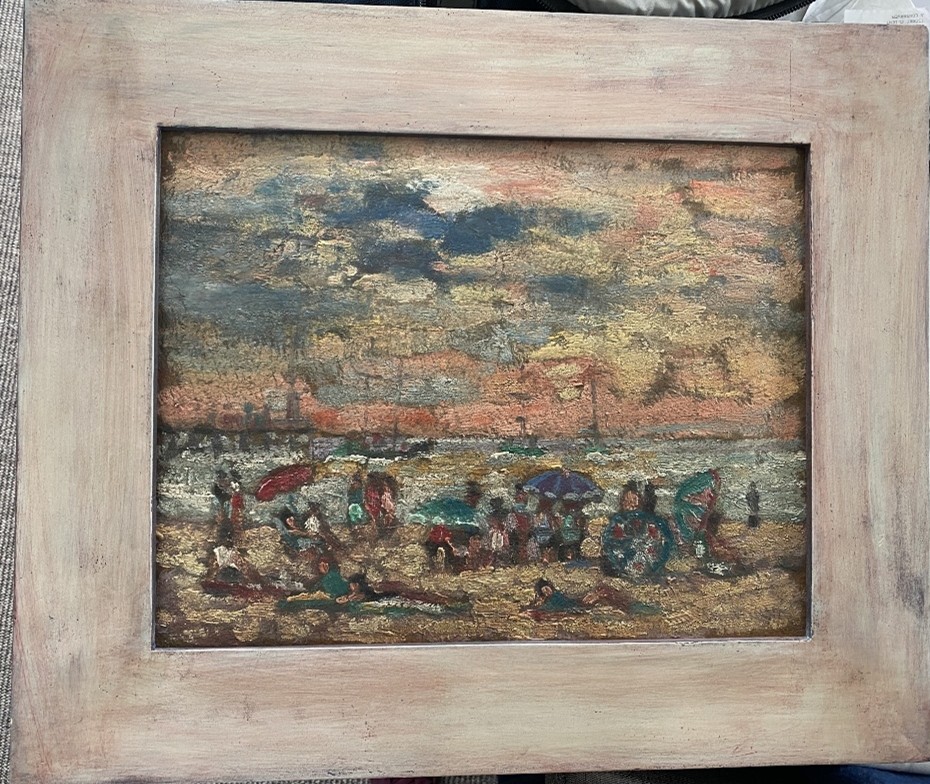
The composition unfolds across three planes : the lively beach in the foreground, the line of bathers at the water’s edge, and the horizon punctuated by three boats, including a two‑masted sailing vessel. The sky plays a decisive role: its shades of pink, ochre, and blue evoke late‑afternoon light, typical of the Emerald Coast where low clouds catch the reflections of the setting sun. On the left, the jetty of the Môle des Noires and its cylindrical lighthouse anchor the scene in an identifiable location. The pictorial surface, built with broad, vibrant strokes, organizes space into colored masses rather than descriptive detail. The work conveys the collective energy of a 1930s beach, a period marked by the expansion of seaside leisure. It aligns with Luce’s late Breton seascapes, in which color structures perception and atmosphere becomes the true subject.
Interpretation
of the work
A late seaside scene — atmosphere, modernity, and rarity within the corpus
This oil on wood holds particular significance within Maximilien Luce’s late production. Beach scenes are less common than his views of ports or rivers, giving the work notable rarity. The identifiable location — the Plage du Sillon and the Môle des Noires — enhances its documentary and topographical value. The wooden support, characteristic of his plein‑air practice in the 1930s, places the work within a period sought after by collectors. Its stylistic coherence with his late Breton seascapes, the atmospheric quality of the sky, and the density of human presence make it representative of his final style. The absence of a visible signature does not weaken the attribution, which rests on a convergence of stylistic, technical, and iconographic indicators. Altogether, it is a desirable work — rare, coherent, and historically grounded.
GALLERY
SPECIFICATIONS


Contact
